 |
||||||||||||||||||||||||||||||||
|
The MSI GT72 Dominator Pro G is that cutting edge gaming laptop with a drool-worthy list of up to the minute components and features that you'd expect
from a boutique brand. There's no last gen CPU here; you get the Intel
5th generation Broadwell CPU most gaming laptop manufacturers skipped
since it was so delayed. It runs Windows 10 out of the box- you don't
have to upgrade it. MSI has been on an impressive roll this year and
they've been refreshing their specs like mad to upgrade to the new CPU
line, include NVIDIA graphics cards at launch and now they've added USB
3.1 and G-Sync for better gaming visuals in the latest Dominator Pro.
The MSI GT72 Dominator Pro G-1666 is the new version of MSI's 17.3"
desktop replacement and gaming laptop. The Pro G model runs on the Intel
Broadwell 5th generation quad core i7-5700HQ 2.7 GHz CPU with Turbo
Boost to 3.5 GHz. The "G" stands for NVIDIA G-Sync technology that syncs
the graphics card and display refresh rates to reduce visual tearing.
It has a lovely 17.3" matte IPS 1920 x 1080 display with a 75Hz refresh
rate.
The Dominator Pro G is available with
the NVIDIA GTX 980M 4 GB DDR5 (our $2,099 model) or the GTX 970M 3 GB
DDR5 in the $1,499 model (MXM upgradable graphics cards for both). It
has 16 gigs of RAM in 4 slots (32 gigs max unless you go with 16 gig
modules), 4 M.2 SSD slots (available in RAID0) and a 1 TB, 7200 RPM HDD.
The laptop has a SteelSeries full color backlit keyboard, Killer WiFi
802.11ac and Ethernet, stereo Dynaudio 3 watt speakers and subwoofer,
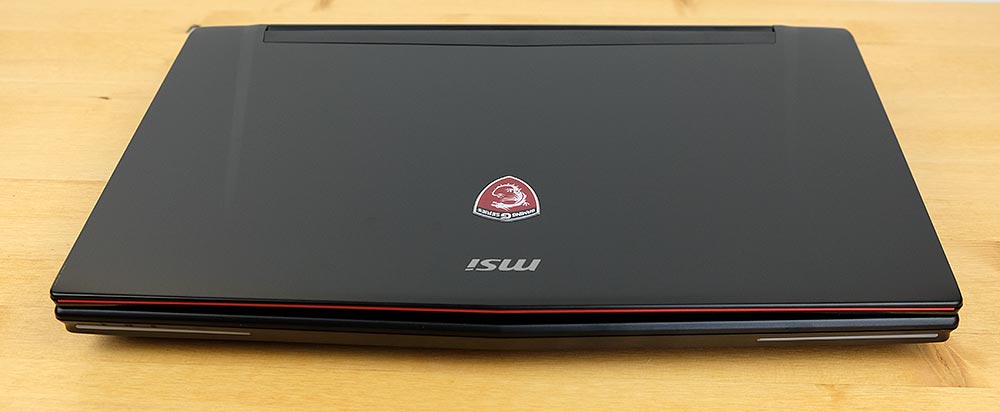
and a Blu-ray burner. The 8.4 lb. laptop has a black aluminum lid and an
easily removable plastic bottom panel for upgrades. It competes with
the Asus ROG G751 and Alienware 17. It's well worth a look if you want
cutting edge specs in a cool and quiet laptop that doesn't throttle.
Design and Ergonomics
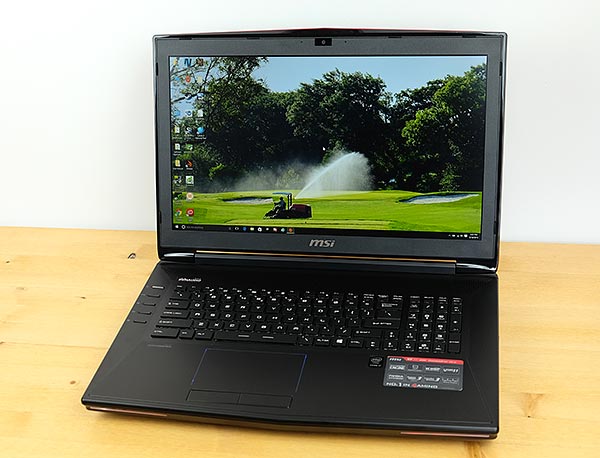
Esthetically, I'm neither a fan of nor
displeased with MSI's gaming laptop designs. It looks a bit more like a
traditional laptop rather than an overstated gaming rig (good for work,
not as much fun at gaming parties). They have achieved a design
uniformity: the super slim and light GS60 Ghost Pro and the Dominator
GT72 are recognizably from the same line now. The sleeker GT72 is a
great esthetic improvement over the older GT70 line, and its 1.89"
thickness suits the machine's overall dimensions so it doesn't look
super-chunky. Like Asus with the ROG G751, MSI hasn't gone overboard
with slimming the laptop as Alienware did with their 2015 models. The
MSI and Asus G751 might not be as slim as the 1.34" thick Alienware 15
and 17, but we're OK with that because there's plenty of room for
larger, quieter fans and more cooling inside. That means the laptop is
nearly silent when doing productivity tasks, streaming 1080p video and
working with pro apps like Adobe Photoshop and even Premiere Pro. When
gaming the fans are audible, but they aren't what I'd call loud. The
keyboard never rises above human body temperature and the bottom remains
cool enough for use on the lap (though at 8.4 lbs. you may find it
tiring on the legs).
The lid is black brushed aluminum and it
attracts fingerprints aplenty. The rest of the casing is durable black
plastic. The keyboard deck's front edge is rounded so it doesn't dig
into the wrist or hands, but it lacks Alienware's and Asus ROG's elegant
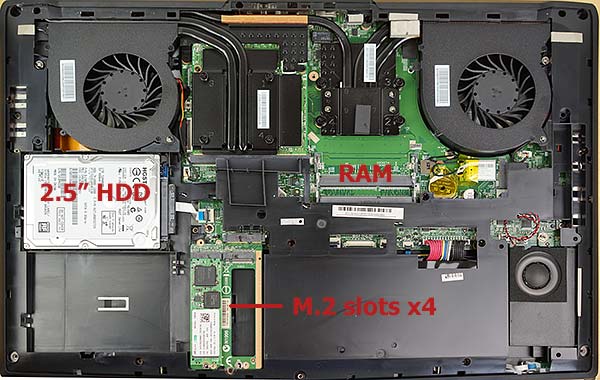
soft touch finish. The bottom panel is removable and grants access to a
plethora of upgradable internals: a 2.5" SATA drive bay, 4 M.2 2280 SSD
slots with SATAIII for RAID0 compatibility, 4 RAM slots, a socketed M.2
wireless card and an MXM graphics card slot. MSI continues to use thin
lids, so there's some flex if you bend the panel intentionally- why
would you do that, though? The hinges are adequate but not as
bounce-resistant as Alienware's super-stiff display mounts.
As with previous MSI gaming models, you
get multicolored LED lighting with 3 keyboard zones, front edge lights
and a light-up MSI dragon logo on the lid. You can customize the colors
or turn off backlighting when you want to be subtle at work. The
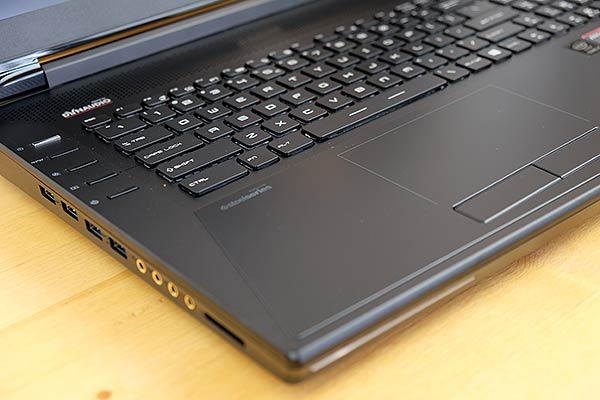
keyboard deck has 4 quick access buttons, one of which cycles through
the 4 LED lighting presets, another that sets the fans to max (I can't
imagine needing to do so), a button for switching between integrated and
dedicated graphics and a program launcher. The top button is the on/off
switch.
MSI gaming laptops have excellent
speaker systems that are louder and fuller than other gaming laptops.
The Dynaudio 2.1 speaker system has 3 watt stereo speakers and a
subwoofer. MSI switched from the very good Creative Cinema 2 software to
Nahimic. I have no qualms with the switch though some users prefer the
old solution. The machine has four 3.5mm audio jacks: 1 headphone/SPDIF,
1 mic, 1 stereo line in and 1 line out for speakers and surround sound
systems.
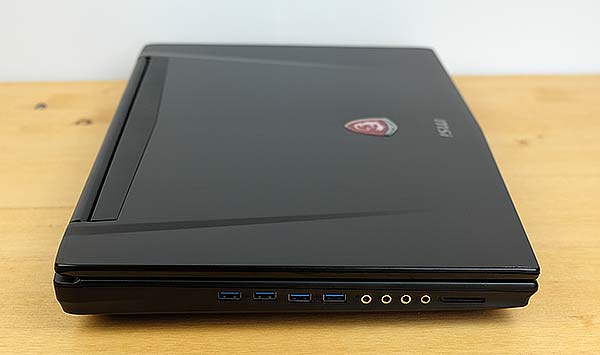
Ports abound on this big machine: 4
audio, 4 USB 3.0 ports, 2 USB 3.1 ports (standard USB connector rather
than USB-C), HDMI, 2 mini DisplayPort, Gigabit Ethernet and an SD card
slot. Killer E2200 Ethernet and Killer 1525 WiFi 802.11ac are standard.
SteelSeries Keyboard and Synaptics Trackpad
Thankfully MSI has moved away from the
simply awful Elan trackpads of old. Synaptics makes excellent trackpads,
but somehow MSI has found a way to make it less than perfect. Tracking
reliability and accuracy are excellent and pinch zooming works well, but
two-finger scrolling works only 50% of the time. Perhaps we'll get a
firmware or BIOS update to improve this: our machine already got one
that improved trackpad performance a bit. The trackpad is delineated by
an LED outline, but there's no physical separator (it's one with the
deck). That means your finger can wander off the trackpad, but it's
large enough that this didn't happen often. The trackpad has two buttons
(plus), but they're much too stiff (minus).
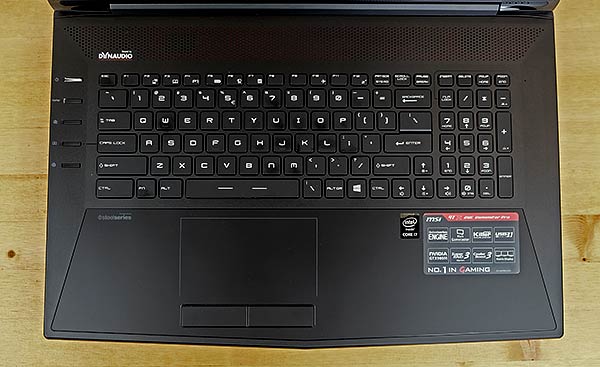
The SteelSeries Chiclet keyboard is
excellent. I confess to slightly prefer the Alienware keyboard, but the
MSI has deep key travel, is uniform in required pressure and as promised
it doesn't ghost in games. The keys are a bit small for a 17" laptop
and the number pad is crammed close, but overall this is a keyboard
that's a pleasure to type on at length and it works perfectly in games.
Display and G-Sync
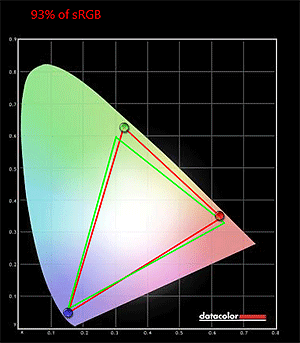
Good times, we have a 17.3" IPS display
with 75Hz refresh rate and a good color gamut of 93% sRGB and 72% of
Adobe RGB. Color tuning out of the box on the default sRGB mode was
quite good and was suitable for professional graphics work and photo
editing. It's also very bright at 323 nits and since it's a matte
display it seems even brighter because it doesn't have to fight glare.
This is a non-touch display with a resolution of 1920 x 1080. Black
levels are average at 0.48 at max brightness and contrast is good at
670:1, but not as high as the 2015 Alienware models. 17" laptop displays
don't get the R&D love that 13 and 15 inch panels do, so there are
no 3K or 4K panels commonly available on the market as of this writing.
MSI standardized on the LG IPS panel
with high refresh rate to comply with NVIDIA G-Sync requirements. What's
G-Sync? It keeps the video card and display refresh rates in sync to
reduce screen tearing and make gaming graphics look smoother overall.
It's very effective and a better solution than Vsync that artificially
caps games at 60 HZ (since that's a common display refresh rate). It's
effective, and even when playing at lower frame rates games are playable
thanks to the smoothness and proper syncing of screen with the game.
Horsepower, Performance and Temperatures
It's chillin' here: MSI has been making
gaming motherboards, graphics cards, laptops and desktops for some time,
and their expertise with cooling is impressive. The MSI GS60 Ghost Pro
impressed us with its quad core i7 and GTX 970M graphics in a crazy
slim, 4.5 lb. chassis--it got (relatively) hot and loud but has kept on
ticking for 9 months since I bought it. With the much roomier and
thicker 17" chassis on the GT72 Dominator line, MSI has room for larger
fans that are both effective and quieter. There's also plenty of room
for heat sinks and pipes, so this machine runs impressively quiet and
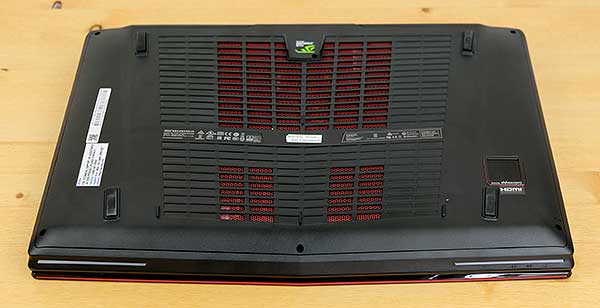
cool despite being one of the most powerful laptops on the market. If
you can bear the weight, the GT72 with the top of the line NVIDIA GTX
980M graphics card stays cool enough to game with the notebook on your
lap (it helps that heat is vented through the back edge). You won't need
to crank up the volume from the excellent Dynaudio 2.1 speaker system
to drown out the fans. Sweet. When gaming with today's most demanding
titles the CPU cores rarely passed 65 C, and the GeForce GTX 980M ran at
54 to 70 C. That's well below the thermal ceiling and we saw no thermal
throttling even after an hour of gaming. Though the machine is quiet
and relatively cool, I do suggest using a passive laptop cooler that
keeps the bottom air intakes clear--it reduces CPU and GPU temps up to
10 C. The 230 watt power supply is adequate for this graphics card, so
it doesn't throttle to reduce power consumption when plugged in.
Broadwell 5th generation 47 watt quad
core CPUs have been almost a no-show since Intel delayed them so long
(soon, Skylake 6th gen will be announced). Better late than never, and
we're glad that MSI chose to release laptops with the Core i7-5700HQ.
This is a standard laptop BGA CPU that's soldered on board since Intel
no longer makes socketed laptop processors (these were only used on a
handful of high end gaming laptops, so we can understand why Intel
didn't find it economically worthwhile). The 2.7 GHz CPU has Turbo Boost
to 3.5 GHz and it can maintain that boost without throttling early.
Broadwell represents a 5% performance gain over Haswell, and more
important for laptops, it's a cooler and more power efficient 14nm CPU
vs. Haswell's 22nm (Skylake and the next gen Kaby Lake will also be
14nm). That said, it's not a night and day difference from Haswell, but
every little bit helps. Skylake should bring another 5% performance
improvement but likely little new in the cooling department. For those
of you who thought this paragraph was techno mumbo-jumbo, here's a quick
translation: this laptop currently runs the latest generation quad core
laptop CPU, and it's one of the very few to do so as of this writing.
It's extremely fast and this laptop can handle the most demanding tasks
from video editing to 3D gaming and CAD. You won't find a laptop
appreciably faster than this.
The Dominator Pro G is available with
your choice of a GeForce GTX 970M 3 GB DDR5 or the GTX 980M 4 GB DDR5 in
our review unit. Both are latest generation Maxwell architecture and
support NVIDIA G-Sync. The 980M is the fastest and most expensive
graphics processor in this generation of NVIDIA graphics cards. Expect
to play today's top titles on high settings and 1920 x 1080 resolution
at 60 fps or higher. It can play quite a few games on ultra settings. If
you want the best money can buy, the Pro G and the much more expensive
18.4" MSI GT80 Titan are it in MSI's lineup.
Benchmarks
PCMark 8 Home: 4432
wPrime: 10 sec. Geekbench 3: 3586/14,144 Unigine Heaven (1080p, high, DX11, AA off, no tess) 73.1 fps, GPU temp 72 C Cinebench R15: OpenGL 74.2 fps
3DMark 11: P11,032, X4243
3DMark Tests:
Fire Strike: 8402 Cloud Gate: 13,414
Battery Life
As with the 2015 Alienware 15,
battery life doesn't have to suffer greatly just because you're using a
big gaming rig. The MSI has a dedicated hardware button for switching
between Intel HD 5600 integrated graphics and the NVIDIA dedicated card.
After you press the button, the machine will restart rather than
switching on the fly using NVIDIA Optimus (we're told this has to do
with G-sync support). I actually don't mind having control over graphics
because I can ensure that I'm using faster dedicated graphics when
needed, and be sure that the machine won't switch to power hungry
dedicated graphics when on the go away from an outlet. When using
integrated graphics with brightness set to a very adequate 40% and WiFi
active, I averaged 6 hours of actual use time in productivity and 1080p
video streaming tests. That's simply marvelous for a quad core 47 watt
CPU and a big 17" display.
The good news is that MSI includes
a proper 230 watt power adapter that provides enough juice to prevent
battery drain when gaming plugged in. Occasionally we see a gaming
laptop with a high consumption GPU like the GTX 880M or 890M with a 180
watt power supply and that results in power based throttling to prevent
battery drain. No such problem here. The GT72 has a 9 cell battery
that's sealed inside. While most upgrades are easy once you remove the
bottom panel, the battery is hidden under a plastic shield and it takes
additional work to access it should you need to replace it in the
future.
| ||||||||||||||||||||||||||||||||
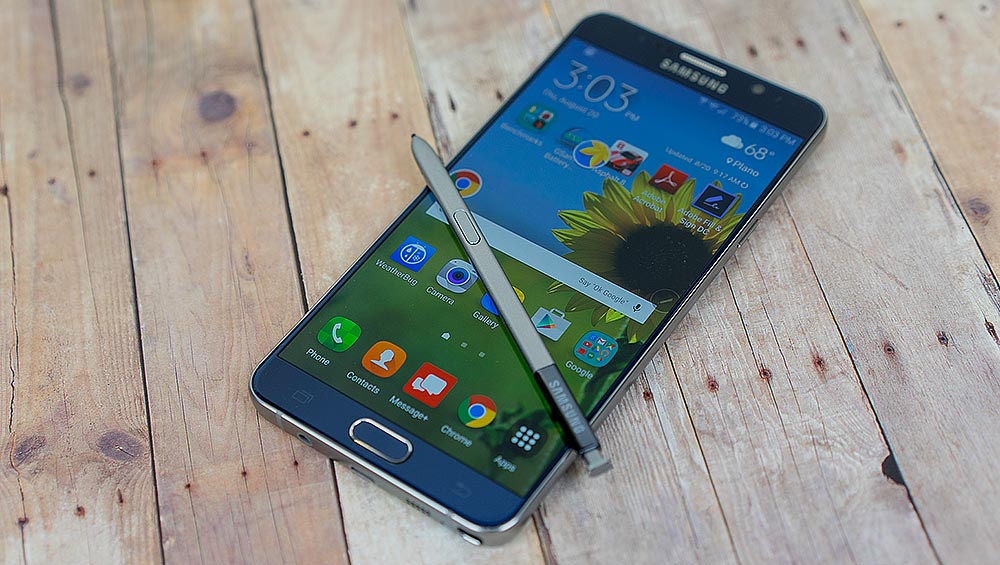 The Samsung Galaxy Note series started with a
controversy: that "phablet" debate, and the Note prevailed. Now there's a
hint of controversy in the air thanks to a major redesign that matches
the Samsung Galaxy S6.
Yes, it's perhaps the first gorgeous Note Android smartphone, but as
with the S6, that beauty comes at a price. In return for a stunning and
compact design executed in Gorilla Glass 4 and metal, you'll give up the
removable battery and microSD card slot. For power users, that might
seem like heresy, and Note folks tend to be power users. Why? The Galaxy
Note is more pocket computer than phone thanks to its huge 5.7" QHD
display, S Pen and fast CPU. But once you see the Note 5 in photos and
in person, I think you'll want one.
The Samsung Galaxy Note series started with a
controversy: that "phablet" debate, and the Note prevailed. Now there's a
hint of controversy in the air thanks to a major redesign that matches
the Samsung Galaxy S6.
Yes, it's perhaps the first gorgeous Note Android smartphone, but as
with the S6, that beauty comes at a price. In return for a stunning and
compact design executed in Gorilla Glass 4 and metal, you'll give up the
removable battery and microSD card slot. For power users, that might
seem like heresy, and Note folks tend to be power users. Why? The Galaxy
Note is more pocket computer than phone thanks to its huge 5.7" QHD
display, S Pen and fast CPU. But once you see the Note 5 in photos and
in person, I think you'll want one.
Samsung's updated fingerprint scanner is
here, and it works just as well as the iPhone 6's scanner. You'll rest
your finger on the mechanical home button to use it (no need to swipe
your finger as with the Note 4). Samsung Pay is coming soon, the
company's Apple Pay competitor that uses magnetic secure transmission
rather than NFC for mobile point of sale payments. Gone are the IR
blaster and AV remote control, but the heart rate scanner under the LED
flash and S Health are here.
Design and Ergonomics
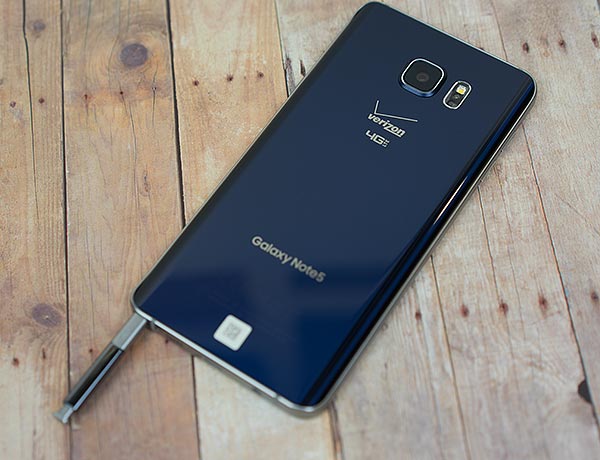
The Galaxy Note 5 looks like a larger
version of the Galaxy S6 and S6 Edge mixed together. The front face
looks like the standard S6 while the back sides are curved, mirroring
the Edge's front face. Samsung reduced the side bezels to make the Note 5
narrower--it's easier to hold and the curves feel good in the hand.
That said, the ultra-thin bezels invite accidental screen input, at
least if your hands are large enough to wrap around the sides. The
phone's look is stunning and the S6 design transfers nicely to the
bigger chassis. The phone is available in black or white glass (gold is
an option overseas) with an aluminum frame on the sides. The metal isn't
slippery but glass is, so beware dropping it, particularly when pushing
on the new spring-loaded S Pen.
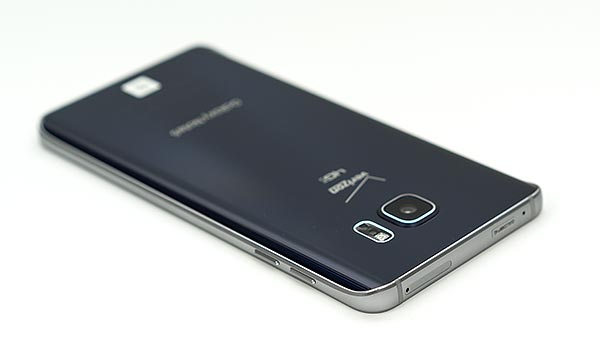
The standard micro USB port, 3.5mm audio
jack and speaker are on the bottom edge, and this is the loudest and
fullest Note speaker we've heard yet. It can't compete with HTC
BoomSound stereo speakers, but volume is more than adequate. Volume
controls are on the left and the power button is on the upper right.
There's a nano SIM card slot up top but no SD card slot. The unibody
design means there's no removable back cover and thus no removable
battery. The phone supports Qi wireless charging out of the box--there's
no need to buy a special back, though you will need a wireless charger
to use that feature.
Horsepower and Performance
The Samsung Galaxy Note 5 runs Android
5.1 Lollipop with Samsung's TouchWiz software on the same Exynos 7420
2.1 GHz octa-core 64 bit CPU as the Galaxy S6 family. That's fine with
us since the Note 5, Galaxy S6, S6 Edge and S6 Edge+ are some of the
fastest smartphones on the market. Unsurprisingly, the Note 5 benchmarks
similarly to those phones, and even better it doesn't feel the least
bit laggy. That's high praise since Samsung's TouchWiz overlay,
lightened though it is, still adds quite a bit of overhead.
The phone is available with 32 or 64
gigs of fast UFS 2.0 flash storage and as mentioned there's no SD card
slot. I know some of you would like to see a 128 gig version since you
can't use a microSD card, and I'd have loved that too (I'd love an SD
card slot even more!). Given the high retail price of the 64 gig model
(~$800), I suspect Samsung thought a 128 gig would be more expensive
than the market would bear.
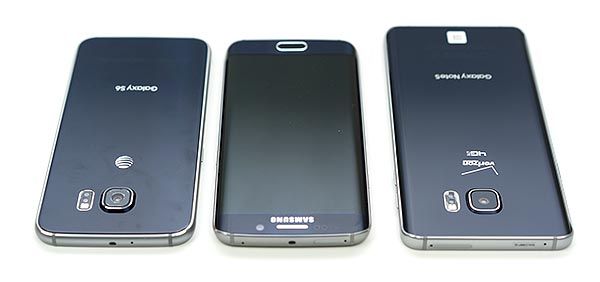
The Samsung Galaxy S6, S6 Edge and Note 5.
Benchmarks
Benchmarks
| Quadrant | 3DMark Ice Storm Unlimited | AnTuTu | Sunspider JavaScript Test (lower is better) | |
| Samsung Galaxy Note 5 | 34,631 | 24,463 | 63,086 | 351 (Webkit)/688 (Chrome) |
| Samsung Galaxy Note 4 | 24,327 | 19,667 | 46,912 | 425 |
| Samsung Galaxy S6 edge+ | 34,422 | 24,397 | 64,059 | 349 (Webkit)/692 (Chrome) |
| Samsung Galaxy S6 | 33,355 | 21,160 | 61,873 | 420 (webkit)/1025 (Chrome) |
| HTC One M9 | 33,733 | 22,168 | 53,582 | 852 |
| LG G4 | 23,730 | 18,655 | 46,043 | 760 |
| LG G Flex 2 | 26,390 | 22,644 | 49,344 | 730 |
| LG G3 | 24,385 | 18,708 | 36,525 | 425 |
| Nexus 6 | 13,595 | 23,520 | 49,961 | 795 |
| Motorola Droid Turbo | 22,709 | 20,735 | 48,332 | 795 |
| Moto X (2nd gen) | 22,170 | 19,924 | 44,340 | 776 |
| HTC One M8 | 24,527 | 20,896 | 36,087 | 776 |
| Sony Xperia Z3 | 21589 | 16,135 | 35,008 | 837 |
| Nexus 5 | 8808 | 17,828 | 27,017 | 718 |
| LG G2 | 19,762 | 9803 (extreme) | 32,990 | 823 |
| Samsung Galaxy S4 | 12,276 | 11,601 | 24,776 | 826 |
Geekbench 3: 1403/4713
Display
Fantastic! The 5.7" QHD 2560 x 1440
Super AMOLED display is one of the best if not the best currently
available on the market. It vastly surpasses the sRGB color gamut and is
the brightest Note display yet. This is the first Note where I can see
the display easily outdoors in the bright Texas summer sun. As per usual
for Samsung's higher end Galaxy models, you can choose from several
color presets. The default is adaptive display mode that alters various
colors' saturation, brightness and contrast to suit the content being
displayed. There's a %100 sRGB mode for those who don't like those Super
AMOLED intense colors that are pretty but unnatural. The display has
relatively low reflectance (as glossy touch screens go), so glare isn't
maddening. Of course, if you don't mind carrying a large phone, your
reward is a huge screen for watching movies, viewing photos and it acts
as an immense viewfinder for the camera.
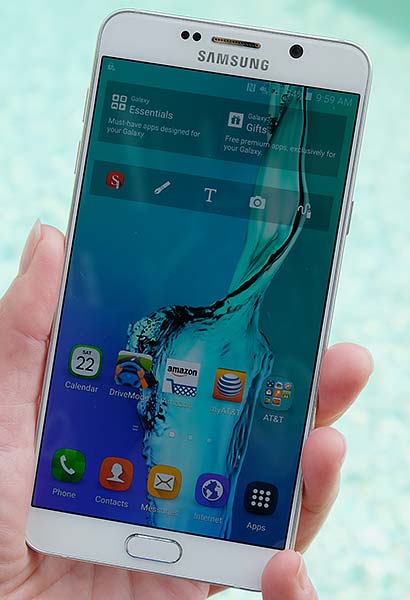
Calling and Data
Samsung's high end Galaxy models often
have superb voice quality. We have AT&T and Verizon Wireless models
in for review, and the AT&T model's voice quality is impeccable
while the Verizon version sounded good but not great. We'll chalk that
up to differences in coverage here in the Dallas metroplex where
AT&T and T-Mobile have the strongest coverage. The phone's earpiece
is quite loud and there's an "extra volume" on-screen button when in
call that really boosts earpiece volume.
The phone has 4G LTE and it uses a
Shannon wireless modem (geek trivia). Data speeds are excellent and
honestly we rarely see significant variance between coeval phones
marketed by a given carrier on that carrier's network. The Note 5
supports HD Voice and WiFi calling (WiFi calling is a carrier-dependent
feature).
Cameras
Samsung uses the same excellent 16MP
rear and 5MP wide angle front cameras as on the Galaxy S6 models.
They've tweaked it a bit, and the result is one of the best camera
phones on the market. The extremely large and colorful viewfinder is a
treat, and photos look that much better when you view them in Gallery or
Photos. The camera uses Samsung's usual UI that we actually like: there
are a plethora of features, manual settings and effects but somehow the
interface isn't cluttered or confusing. You can direct record video to
YouTube, use auto HDR, take photos while also recording video and
there's a 4K video mode. The camera has OIS (optical image
stabilization) to ameliorate the shaky hand dilemma, though it won't
help with jumpy or fidgety subjects (the camera is stabilized, not the
world around it). The Samsung Galaxy Note 5 and Samsung Galaxy S6 Edge +
give the LG G4 serious competition and surpass the iPhone 6 and iPhone 6 Plus for photo and video quality.
The front camera is relatively sharp and
colorful with little of the usual front camera blocky noise when using
video chat. Given the popularity of selfies, I'm sure no one minds
having higher quality 5MP stills of themselves and surrounding friends.
S Pen
The S Pen is back, and this time
it lives in a spring-loaded silo. Push in to release it and push in
again to lock it in place. The pen is similar in size to the last gen
model's pen and it's still plastic though it looks like metal. Inside
it's using Wacom technology with pressure sensitivity and palm rejection
so you can rest your hand on the glass as you write or draw. Air
Command, Multi-Window (with resizable floating app windows) and other
Samsung staples are here. When you pull the pen out of the silo, the
phone launches a handy palette of customizable pen-related app
shortcuts, including a screen capture and annotate feature, quick note
and S Note. In fact, you can even write a note when the phone is
sleeping. Just pull the pen out of the silo and start writing on the
black screen (in white ink). You can save that file for use later. This
feature works even if you've PIN or fingerprint locked the phone.
As ever, S Pen is a treat if
you're an avid "note to self" type or an artist craving a digital art
pad. It's also handy for drawing diagrams, quick maps and equations.
Oddly, Samsung decided to "clean up" S Note, and the handwriting to text
conversion and equation recognition are now free optional downloads.
You'll have to go to the S Note main screen (you can't be in a note) and
use the menu to select optional add-ons if you want those features.
|
Battery Life
The Samsung Galaxy Note 5 has a
3,000 mAh Lithium Ion battery that's sealed inside (I know, I know, some
of you hate this change). It supports quick charging as well as
wireless charging and a quick charger is included in the box. Battery
life is good, but not groundbreaking. We've averaged 4.8 hours of actual
screen on time with auto-brightness enabled, and for moderate use that
translates into a full day to 1.5 days. Some older Note models actually
managed 1.5 to 2 days, but recent generations' battery runtimes have
shortened as screens get bigger, brighter and higher resolution while
processor speeds also move upward. Then there's LTE 4G, a power hungry
technology.
As a consolation for the loss of a
removable battery, the phone's quick charge feature is extremely fast,
and as with the iPhone and other sealed smartphones, you can use one of
the many portable USB battery packs on the market to top up the battery
on the go.

Exploit kits are more successful because enterprises don't patch fast enough
Cisco is reporting that successful exploits of Flash vulnerabilities are
soaring, partly because they are rapidly being incorporated in kits
that take advantage of the flaws as well as because enterprises aren't
patching fast enough, which leaves them open to attack.
For the first five months of 2015, the Common Vulnerabilities and
Exposures project has reported 62 Adobe Flash Player vulnerabilities
that resulted in code execution on user machines, Cisco says in its 2015 Midyear Security Report.
That's more than the annual totals for any year back to
2001. The closest year was 2012 with 57 such vulnerabilities, but CVE
still has seven more months to report on in 2015.
Cisco
says Flash exploits are being rapidly integrated into widely used
exploit kits such as Angler and Nuclear. Authors of the Angler and
Nuclear kits included exploits of newly published vulnerabilities within
days of them being publicly announced, the report says, and Flash
upgrades by users lag.
The effectiveness of the exploits in these kits is enhanced by the fact
that users are failing to install updates that patch the vulnerabilities
in a timely manner, Cisco says. "It appears many users have difficulty
staying on top of Adobe Flash updates and perhaps may not even be aware
of some upgrades," the report says.
In addition to quickly jumping on new exploits, Angler has
other features that boost its effectiveness, Cisco says, enough so that
the report crowns Angler as the leader in exploit-kit sophistication and
effectiveness.
That's because the kit can identify which
weaknesses victim machines have and downloads appropriate malicious
payloads to exploit them, Cisco says. Angler's success rate is 40
percent against devices that hit one of its landing pages. That compares
to just 20 percent on average for all other exploit kits, the report
says.
Angler
uses domain shadowing to trick victims. This is the practice of
compromising the accounts of legitimate domain-name registrants, then
creating subdomain names in their accounts. They use the subdomains to
point to Angler servers that host malicious landing pages.
Cisco
says Angler is responsible for 75 percent of all known subdomain
activity of this sort by exploit kit authors since last December. In
addition, the actors behind Angler change the IP addresses of their
malicious sites many times per day to avoid detection.
Often the malware they deliver is ransomware, such as Cryptowall that encrypts victim machines until the victims pay a sum to have them decrypted.
The
Cisco report also says these exploit kits also deploy Dridex, a banking
malware that relies on Microsoft Office vulnerabilities to wage
malicious macro attacks. They typically go undetected long enough to be
effective then cease after antivirus vendors publish signatures for
them.
Corporate security pros need to be on the lookout
for malware designed to evade detection and also damage the operating
systems of the machines it infects if detection efforts become too
persistent, the report says. It uses Rombertik as an example of such
malware because it performs pointless operations while it is in security
sandboxes in an effort to wait out analysis or to delay discovery.
Rombertik
attempts to overwrite master boot records and if it fails, will destroy
all files in users' home folders. Should it go undetected, then it
starts its primary function, stealing data typed into browsers. "It's a
solid bet other malware authors will not only appropriate Rombertik's
tactics but may make them even more destructive," the report says.
Sandbox detection in malware is on the rise, making it harder for enterprises to discover it.
The
report says spam levels remain about the same and that coding errors
continue to introduce exploitable flaws into software. "Vendors need to
place more emphasis on security within the development lifecycle, or
they will continue to spend time and money on catch-up efforts to
detect, fix, and report vulnerabilities," the report says.
Java-based
exploits are on the decline, with no zero-day exploits being discovered
since 2013. Improved patching and security improvements have made the
difference, Cisco says.

The latest version of the language features improved garbage collection, mobile accomodations, and a runtime rewritten in Go
Go 1.5,
released today, improves the Google-developed language by adding
concurrent garbage collection, leveraging all processor cores by
default, and letting developers use Go to write background logic for
mobile apps
Read Now
The up-and-coming open source language, which boasts Docker as a marquee application that has used it, is well-suited for network applications and command-line apps. Version 1.5 is the sixth major stable release of the language.
Download the Devops Digital Spotlight
With vastly increased demand for new code, enterprises can no longer afford long, slow developmentRead Now
"With Go, we're trying to make programmers more productive,
and the way that we chose to do that was build a working a system, a
working programming language stack," said Russ Cox, Google principal
engineer for Go, in an interview.
The concurrent garbage collector improves latency by making pauses incurred by the collector while the program runs much shorter, Cox said. Now, Google is seeing pauses in the range of 10 to 20 milliseconds for a 10GB program, as opposed to a 1-to-2-second pause.
Version 1.5 also has its language runtime and compiler rewritten in Go, converted from the C language. This creates tighter integration between the parts of the language: Written in Go, the compiler already knows about Go concepts, such as garbage collection. Converting the runtime to Go enabled the changes to garbage collection.
Developers using Go 1.5 will no longer have to specify use of processor cores; this will be done by default via the scheduler. "The garbage collector and the main program can run on different threads and different cores," Cox said.
With Google's "Go mobile experiment," leveraged in the upgrade, developers can write a C program that calls Go as a library; version 1.5 also features new operating system and architecture ports for darwin/arm64 and linux/arm64. The combination of being able to call Go from C or C++ programs and having a port for Darwin on ARM enables the Go mobile experiment, which is "exploring the use of Go as an NDK (Native Development Kit) language, a native language on mobile devices that are running both Android and iOS," Cox said.
Go could be used as an NDK language to write background network logic for Android and iOS applications. Many apps, especially games, have Java or Objective-C running the UI, but native code is used to run the main logic of the game or app, Cox said. "The idea here is where you're using C++ today, you could use Go, instead."
The release also features experimental support for ppc64 and ppc64le (IBM PowerPC 64-bit, big and little endian), and internal developer tools have been improved. Support for "internal" packages permits sharing of implementation details between packages, while experimental support for "vendoring" external dependencies serves as a step toward a standard mechanism for managing dependencies in Go programs. Vendoring pertains to copying source code written by others into the developer's own source tree, to have some control over it.
Version 1.5 features a
The lone language change was the lifting of a restriction in the map literal syntax, to improve succinctness and offer consistency with slice literals. Standard library improvements in Go 1.5 include cleaner usage messages in the flag package and a Float type in the math/big package, for computing with arbitrary-precision floating point numbers. An improvement to the DNS resolver on Linux and BSD systems removes the cgo requirement for programs that perform name lookups.
The concurrent garbage collector improves latency by making pauses incurred by the collector while the program runs much shorter, Cox said. Now, Google is seeing pauses in the range of 10 to 20 milliseconds for a 10GB program, as opposed to a 1-to-2-second pause.
Version 1.5 also has its language runtime and compiler rewritten in Go, converted from the C language. This creates tighter integration between the parts of the language: Written in Go, the compiler already knows about Go concepts, such as garbage collection. Converting the runtime to Go enabled the changes to garbage collection.
Developers using Go 1.5 will no longer have to specify use of processor cores; this will be done by default via the scheduler. "The garbage collector and the main program can run on different threads and different cores," Cox said.
With Google's "Go mobile experiment," leveraged in the upgrade, developers can write a C program that calls Go as a library; version 1.5 also features new operating system and architecture ports for darwin/arm64 and linux/arm64. The combination of being able to call Go from C or C++ programs and having a port for Darwin on ARM enables the Go mobile experiment, which is "exploring the use of Go as an NDK (Native Development Kit) language, a native language on mobile devices that are running both Android and iOS," Cox said.
Go could be used as an NDK language to write background network logic for Android and iOS applications. Many apps, especially games, have Java or Objective-C running the UI, but native code is used to run the main logic of the game or app, Cox said. "The idea here is where you're using C++ today, you could use Go, instead."
The release also features experimental support for ppc64 and ppc64le (IBM PowerPC 64-bit, big and little endian), and internal developer tools have been improved. Support for "internal" packages permits sharing of implementation details between packages, while experimental support for "vendoring" external dependencies serves as a step toward a standard mechanism for managing dependencies in Go programs. Vendoring pertains to copying source code written by others into the developer's own source tree, to have some control over it.
Version 1.5 features a
go tool trace command, which enables visualization of program traces generated by a new tracing infrastructure in the runtime. A go doc command, meanwhile, serves as a substitute for the original godoc command that provides an improved command-line interface.The lone language change was the lifting of a restriction in the map literal syntax, to improve succinctness and offer consistency with slice literals. Standard library improvements in Go 1.5 include cleaner usage messages in the flag package and a Float type in the math/big package, for computing with arbitrary-precision floating point numbers. An improvement to the DNS resolver on Linux and BSD systems removes the cgo requirement for programs that perform name lookups.

An engineer holds a Lithium-ion battery cell used in its backup battery
By eliminating liquid electrolytes, the batteries eliminate fire risk. Samsung and MIT see it as a power storage 'game change
Researchers have developed a new material for a basic battery component that they say will enable almost indefinite power storage.
The
new material -- a solid electrolyte -- could not only increase battery
life, but also storage capacity and safety, as liquid electrolytes are
the leading cause of battery fires.
Today's common lithium-ion batteries use a liquid
electrolyte -- an organic solvent that has been responsible for
overheating and fires in cars, commercial airliners and cell phones.
With a solid electrolyte, there's no safety problem.
"You
could throw it against the wall, drive a nail through it — there's
nothing there to burn," said Gerbrand Ceder, a professor of materials
science and engineering at MIT and one of the main researchers.
Additionally,
with a solid-state electrolyte, there's virtually no degradation,
meaning such batteries could last through "hundreds of thousands of
cycles," Ceder added.
Organic electrolytes also have limited electrochemical
stability, meaning they lose their ability to produce an electrical
charge over time.
Along with MIT, scientists from the
Samsung Advanced Institute of Technology, the University of California
at San Diego and the University of Maryland conducted the research.
The researchers, who published their findings in the peer-reviewed journal Nature Materials, described the solid-state electrolytes as an improvement over today's lithium-ion batteries.
Electrolytes are one of three main components in a battery, the other two being the terminals -- the anode and the cathode.
A
battery's electrolyte component separates the battery's positive
cathode and negative anode terminals, and it allows the flow of ions
between terminals. A chemical reaction takes place between the two
terminals producing an electric current.
A past problem
with solid electrolytes is that they could not conduct ions fast enough
to be efficient energy producers. The MIT/Samsung team says it overcame
that problem.
Another advantage of a solid-state lithium-ion battery is that it can perform under frigid temperatures.
Ceder said solid-state electrolytes could be "a real game-changer" creating "almost a perfect battery."

A rider on a sensor-equipped BMX jumps over Intel CEO Brian Krzanich at IDF
If you’ve paid any attention to Intel’s developer event in San Francisco
this week, you’ve probably gathered already that there’s almost no chip
news at the show. Intel has moved up the food chain, so to speak, and
is showing developers what they can build with its technologies rather
than focusing on new components.
It makes sense, since with PCs on the wane Intel needs developers to get
creative with its products. It can no longer flash a faster Core i7
chip and expect them to go do something interesting with it, because PCs
nowadays just aren’t that interesting. Instead, it needs to show them
what else they can do with its latest chips.
So we’ve been hearing a lot about robots, depth-sensing
cameras, smart vending machines and bracelets that log you into your PC.
It’s important stuff for Intel, and entertaining to watch a
sensor-equipped BMX bike jump over the head of CEO Brian Krzanich. But
there’s not a ton of big news we hadn’t heard about before.
Still,
here are 5 of the most interesting things announced so far, and since
we’re already halfway through IDF there probably won’t be much else.
SmartSound and Wake on Voice
Intel
didn’t talk much about its upcoming Skylake desktop CPUs this week, but
it did reveal that the chip has an integrated DSP used for a feature
called Intel Smartsound, whch will allow computers to listen out for
audio signals without using up too much power.
It worked
with Microsoft to build an upcoming technology for Windows 10 called
Wake on Voice, which will let you walk up to a Windows 10 in sleep mode
and bring it to life by saying “Hey Cortana.” Some smartphones already
have this always-listening feature, but it’s not available yet on a PC.
The
catch is, we’re told Wake on Voice won’t arrive with the first Skylake
chips, which means it won’t be supported in the first wave of Windows 10
PCs.
Button-sized Curie chip coming in Q4
OK, there was a little bit of chip news. Curie is Intel’s tiny system-on-chip for wearables. Unveiled at CES earlier this year, it's as big as a fingernail and includes a Quark microprocessor, Bluetooth radio, accelerometer, and gyroscope.
Intel
announced this week that "select” hardware makers will get their hands
on Curie to build products in the fourth quarter. Regular developers
will get it too at the Maker Faire in Rome, Krzanich said, which takes
place in October.
As well as rings, bracelets and fitness
trackers, Curie can be embedded in just about anything. Intel showed
how you can track the speed and position of a BMX bike that apparently
had Curie chips on its handlebars and saddle. It also released some new
SDKs, including one called Identity IQ, which can authenticate a
wearer's identity. That could eventually let you unlock your PC using a
smart bracelet, as Krzanich demonstrated in his keynote.
 Intel
Intel
Intel's Curie SOC for wearable computers
RealSense goes everywhere
RealSense
is Intel’s 3D depth-sensing camera. It uses three lenses - a standard
2D camera, an infrared laser and an infrared camera. It basically allows
a computer to “see,” and Intel has already shown a drone navigating
through trees in the woods using RealSense.
It’s already
in some PCs, and at CES Intel showed the first prototype smartphone with
RealSense. This could allow several handy uses. RealSense can be used
to measure distances, so you can go furniture shopping and use your
smartphone as a tape measure. It can also take photos that allow you to
adjust the focus later, a bit like a Lytro camera, and it can be used to
scan objects for sending to a 3D printer.
RealSense is the most pervasive technology at IDF.
It’s also being shown in a vending machines that can tell the sex and
age of the person standing in front of it, and in a robot bellhop that
will deliver drinks to your hotel room. it’s also in gaming systems,
including a new camera from Razer to use on the Twitch game streaming
service.
Intel will launch the first products next year based on 3D
XPoint, a new memory type it developed with Micron. Intel claims it will
be 10x as dense as DRAM and 1,000 as fast as NAND Flash - although
speed tests on stage revealed the initial performance gain to be closer
to just 7x.
Under a new brand called Intel Optane, Intel
will launch SSDs for servers and PCs next year, and also memory DIMMs
for servers. Intel says 3D XPoint will supercharge everything from PC
gaming to in-memory databases.
Intel is sponsoring a reality show?
Strange
but true, Intel has partnered with United Artists to produce a reality
TV show called "America's Greatest Makers." It will follow the trials
and travails of inventors cometing to build the greatest wearable or
gadget using Intel's Curie chip, and the winner will get a $1 million
prize.
 InterDigital's EdgeHaul antenna uses beam
forming to aim the signal, and is a precursor to the antennas that will
help speed up 5G networks.
InterDigital's EdgeHaul antenna uses beam
forming to aim the signal, and is a precursor to the antennas that will
help speed up 5G networks.An initiative backed by the likes of AT&T, Intel and Qualcomm is hoping to accelerate the rollout of cellular networks customized for machine-to-machine communications
Backed by the likes of AT&T, Intel, and Qualcomm,
industry organization GSMA has launched an initiative to accelerate the
roll out of cellular networks customized for machine-to-machine
communications.
The growing interest in
machine-to-machine communications has resulted in a need for so-called
LPWA (Low Power Wide Area) networks that are customized for applications
that have low data rates, long battery lives, and operate unattended
for long periods of time.
Today a lot of different technologies and their backers are
vying to dominate this burgeoning area. With the forming of the Mobile
IoT Initiative, the cellular industry is aiming to pool its resources
and accelerate the commercial availability of services.
It
hopes to do this this with demonstrations, proofs of concept and trials
of a selection of LPWA technologies. The members of the initiative will
also provide analysis and feedback to help standards organization 3GPP
standardize the technologies. The GSMA is also working on improving IoT
security, an area that needs work as recent revelations of hacked cars
have shown.
No single network technology is capable of addressing all use cases, so the initiative will focus on developing LTE and GSM.
"We
already have cellular networks out there, and need to make better use
of those networks," said Shane Rooney, executive director at the GSMA.
A third alternative is just known as Clean Slate, which proposes to combine a new radio with GSM frequencies
Initial
specifications for cellular LPWA networks are expected to be completed
by the end of 2015, with a first implementation in early 2016 and
commercial rollouts following later in the year, according to the GSMA.
The
initiative is backed by mobile operators, network equipment vendors and
chip makers, including AT&T, Alcatel-Lucent, China Mobile, Deutsche
Telekom, Ericsson, Huawei Technologies, Gemalto, Intel, KDDI, Nokia,
NTT DoCoMo, Orange, Sierra Wireless, Telefonica, Telstra, and Vodafone.
The Mobile
IoT Initiative and its backers are far from alone in wanting to develop
the networks that will carry machine-to-machine traffic. For example,
the LoRa Alliance, whose members include IBM and Cisco Systems, is
promoting the LoRaWAN protocol as the foundation for wide-area networks.
Other
candidates in use or under development are Weightless, RPMA (Random
Phase Multiple Access) from On-Ramp Wireless, and a technology from
French company Sigfox.
It's still early days, and the
industry is now in a land-grab phase where everyone is trying to get
ahead to establish their presence, according to Gartner analyst Nick
Jones. The IoT networking sector will remain very confused for several
years, and at least ten different technologies will gain traction, he
said earlier this year.

A data-processing solution from Mesosphere leverages Spark, Kafka, and Cassandra -- but eschews Hadoop -- for enterprise level real-time big-data needs
Mention big-data tools like Spark and Kafka to most
enterprise users, and the other big-data tool that comes to mind along
with them is Hadoop. But does it need to?
Mesosphere,
corporate backers of the Apache Mesos cluster-management project, are
ginning up a big-data stack that eschews Hadoop, but embraces Spark (and
Kafka, and Cassandra, and the Akka event framework) for real-time
processing.
Mesosphere Infinity
is "a turnkey, full-stack offering optimized for big data and IoT," and
its main aim is to provide an easily erected stack for businesses for
real-time data work. It also stands as a recent example of how many of
the technologies reflexively associated with the Hadoop stack don't
require Hadoop to be useful.
Look, ma, no Hadoop
Matt
Trifiro, chief marketing officer for Mesosphere, explained in a phone
conversation how Infinity is managed by another Mesosphere creation: Mesosphere DCOS,
which allows entire data centers full of applications to be stood up
easily. Infinity, in turn, is for managing a relatively narrow range of
applications: Spark for data processing; Kafka for real-time data
ingestion; and another Apache Foundation project, Cassandra, for data
storage.
While
Infinity "doesn't exclude Hadoop," said Trifiro, "it doesn't require
it, either. You can use [Hadoop's] HDFS as a persistent data store, and
you may have Hadoop processing over data pushed into Cassandra, but in
terms of real-time acquisition, you need a specialized stack."
Sparks of inspiration
Spark has drawn attention
as of late from a roster of A-list technology firms interested in both
investing in the project and leveraging it for heavy-duty business
analytics work. Still, like many other open source data tools, Spark is
by itself far more "project" than "product" -- it isn't a trivial effort
to use in an enterprise environment.
Trifiro
claims Spark and the rest of the Infinity stack "was built from
observation of what people were putting into production." Businesses
were attempting to put together Spark and Kafka stacks for real-time
analysis, said Trifiro, because "the demand for processing real-time
data by non-Web companies is relatively new, and there's immense
pressure on IT teams to do this." Standing up an entire such stack has
"historically required a lot of expertise," and Infinity is meant to
require minimal work to get up and running.
Mesosphere
plans to make Infinity's stack even easier to consume by offering it via
existing cloud services. Right now, though, the only named partner for
cloud-based enterprise distribution is Cisco, the same company that
worked hand-in-hand with Mesosphere to build Infinity.
One
possible analogy is with running applications in containers, versus
using virtualization and OpenStack. Containers offer a potentially more
precise solution to the problems of running applications at scale than
VMs did. Likewise, Spark alone, as opposed to Spark plus Hadoop, might
present a better fit for the data-processing problems faced by
enterprises -- as long as deployment and management of a Spark stack
doesn't put them back at square one.

A building on the Microsoft Campus
Credit:
Stephen Brashear/Getty Images
A new report from Okta shows businesses picking up Microsoft's office suite
Microsoft's Office 365 has passed Salesforce.com as the most
popular service among companies that use Okta's device and identity
management products, according to a new report released Thursday.
From
November 2013 to June 2015, Microsoft went from being the fourth most
popular service to passing Google Apps, Box and recently Salesforce.com
to become the most-used app among the more than 2,500 companies that
rely on Okta's services. Those businesses range from large enterprises
like Intel to smaller firms with fewer than 250 people.
 Unsurprisingly, 74 percent of large businesses with more
than 4,000 employees run only Office 365, while just 50 percent of
businesses with fewer than 250 employees subscribe only to Microsoft's
office suite. It's most popular in the U.S., Canada and Western Europe.
Unsurprisingly, 74 percent of large businesses with more
than 4,000 employees run only Office 365, while just 50 percent of
businesses with fewer than 250 employees subscribe only to Microsoft's
office suite. It's most popular in the U.S., Canada and Western Europe.  Okta
Okta
Percentage of businesses using Office 365 vs. Google Apps
The massive adoption of Microsoft's
new Office services has been driven by companies that want to use
Exchange Online, according to Okta Chief Product Officer Eric Berg.
"I would say my street knowledge tells me that predominantly people are buying Office 365 for hosted Exchange," he said.
In
addition, Berg said that Microsoft has an advantage over other services
like Google Apps because they don't have to retrain employees who are
already familiar with using Office for tasks like sending and receiving
email through Outlook.
He went on to say that businesses
implementing Office 365 will likely be rolling it out to many more
users than something like Salesforce, since it includes applications and
services like email that are applicable to most if not all of the users
in an enterprise compared to something like Salesforce that's tailored
for one part of the organization.
 Okta
Okta
The number of customers using Office 365, HipChat, Slack, Yammer and AsanaWhile Office 365 is ascendant, those gains didn't translate
into user growth for Yammer, the enterprise social networking service
that Microsoft bundles with many editions of its office suite. That
service's user growth flatlined over the past few months, even as other
applications exploded in popularity.
Berg,
a former director of product management at Microsoft, said that the
company has added Yammer as a feature of many of its Office 365 plans to
encourage adoption.
"I think what you see happening here
in the data is that Yammer, as an entity, as a product, as a business
has lost a lot of focus independently in pushing [itself]," Berg said.
"And what they've been focused on is integrating into Office 365, and
their bet is just as that hockey stick curve is going up on Office 365,
that's at least going to get everybody who buys that exposure to Yammer.
Whether or not they actually use it, that's another question."
While
Yammer isn't showing massive gains, its quasi-competitor Slack has seen
major adoption among Okta's users, with its customer base growing 50
percent between April 2015 and June 2015 alone. Customers who want to
use Okta's tools with Slack have to pay for the service, to boot --
there could be an even larger population of companies out there who are
choosing to just use its free tier and not integrate it with Okta.
Overall,
Berg said that the potential for new companies to come in and release a
product that takes the business world by storm depends on what market
they plan on entering. The enterprise collaboration world is still open
to new entrants, but it's going to be more difficult for other companies
to shake Microsoft's dominance with Office 365.
Samsung has unveiled a pair of new 55-inch OLED displays
— one of which is transparent, and the other functions as a mirror.
Both, the company says, can do wonders for the worlds of retail and
advertising, but let's face it, they also look very, very cool. While
mirrored and transparent LCD displays have been around for a while now,
Samsung says its OLED technology (the first of its kind) offers better
contrast and viewing angles. The company says that while the transparent
displays might be used for (slightly dull) tasks like better signage,
mirrored OLED panels could be combined with Intel's 3D RealSense cameras
to create virtual changing rooms. We imagine the same technique could
be applied to ads too, although a world full of shop fronts that dress
you up as you walk by sounds just a tad hellish to us.


Samsung showed off the PM1633a, a solid-state drive
capable of storing nearly 16 terabytes, at the Flash Memory Summit in
California this week
If you like to hoard your digital files, then Samsung has made the hard drive for you.
The South Korean tech giant showed off the PM1633a, a solid-state
drive capable of storing nearly 16 terabytes, at the Flash Memory Summit
in California this week. It comes in a 6.35-cm case, which means it
could theoretically fit inside a conventional lap top.
While the drive actually holds 15.36 TB, it still has, by far, the world's highest storage capacity. Its closest competitors are 10 TB drives made by HGST and Western Digital.
As the Telegraph newspaper reports, that means the device could, in theory, store the equivalent of 284 days worth of high-definition video, or about 3.8 million four megabyte songs.
While Samsung did not provide any details on price or availability, technology site Slash Gear reported it could cost northward of $5,000. Based on the company's demonstration — 48 of the solid-state drives installed in a single server with a total storage capacity of about 738 TB — the drive is intended for the enterprise market.
The Verge, an American technology news and media network, points out that it's technically not a hard drive at all, since solid-state drives contain no spinning platters, or disks, and no motor that drives the disks.
"But really, we all just think of a hard drive as the component where you store stuff on a computer, and this PM1633a can store more stuff than anything else," wrote Verge journalist Dieter Bohn.
Banks have been sending millions of Americans credit and debit cards equipped with computer chips to improve the security of in-store purchases.
Meanwhile, banks and credit card companies are pushing merchants to upgrade their payment terminals so they can read the chips on the cards and bring the U.S. in line with credit card security used in much of the rest of the world.
Meanwhile, banks and credit card companies are pushing merchants to upgrade their payment terminals so they can read the chips on the cards and bring the U.S. in line with credit card security used in much of the rest of the world.
The conversion process from older magnetic stripe cards to chip cards has sped up in recent months because of an Oct. 1 deadline. That's the day when liability for credit card fraud will shift from banks to merchants or the party using the least-secure technology. Credit card users, who won't bear liability for fraud, are unlikely to notice the deadline at all.
However, card users might want to know what's happening so they'll be ready when lines form at checkout lanes this holiday shopping season because merchants will have begun deploying chip-card readers. Some industry analysts say chaos will ensue because chip cards take a few seconds longer to read than magnetic stripe cards, and some customers and store clerks will be unfamiliar with how to use them.
The following is information you can share with other shoppers (after Oct. 1) if you happen to be (patiently) waiting in line at the checkout counter.
Chip card image
However, card users might want to know what's happening so they'll be ready when lines form at checkout lanes this holiday shopping season because merchants will have begun deploying chip-card readers. Some industry analysts say chaos will ensue because chip cards take a few seconds longer to read than magnetic stripe cards, and some customers and store clerks will be unfamiliar with how to use them.
The following is information you can share with other shoppers (after Oct. 1) if you happen to be (patiently) waiting in line at the checkout counter.
Chip card image
 What's a chip card?
A chip card, also called a smart card, is a credit or debit card with a computer chip embedded in the face of the card. That's the only difference in its appearance. Nearly all of the chip cards that banks are sending their customers still have magnetic stripes that will be used by stores that don't have chip-card readers. Magnetic stripe technology is decades old and is still widely used in the U.S. even though it is relatively easy to hack.
According to industry estimates, about half of the 12 million card readers at payment terminals in the U.S. will be converted to support chip cards by the end of 2015. Meanwhile, there are about 1.2 billion debit and credit cards in circulation among the 335 million people who live in the U.S. Eight major banks account for half of the U.S. card volume; they estimate that nearly two-thirds of their cards will be reissued as chip cards by the end of the year.
There are 3.4 billion chip cards in use worldwide, primarily in 80 countries, according to the EMV Connection website. EMV stands for Europay, MasterCard and Visa, the companies that originally developed chip cards.
The numbers are important because there won't be a complete conversion to chip cards for many years. It took Canada about eight years to reach 90% conversion to chip cards. Major retailers like Wal-Mart have been converting payment terminals to support chip cards for years.
How do I use a chip card?
GoChipCard.com, a website supported by major banks and credit card companies, posted a three-step illustration for how to use a chip card. Step 1 is to insert the card at the bottom of the terminal, with the chip toward the terminal facing up. That's instead of swiping the magnetic stripe along the side of the machine.
Many new terminals will support both methods, as well as NFC payments via smartphones and smartwatches such as the latest iPhones or the Apple Watch, which use Apple Pay. NFC payments are usually done by just touching, or nearly touching, a device to a payment terminal and entering a confirmation on the phone. In addition to “touch and pay” with a smartphone, some retailers like Rite-Aid will support the ability to touch the terminal with a chip card to pay.
 As the GoChipCard graphic notes, a key detail of the first step is that users should not remove the card from the reader "until prompted." Analysts have noted that, on the first few tries, U.S. shoppers who are accustomed to swiping magnetic stripes may be likely to remove their chip cards quickly. Sales clerks will have to be ready for this -- and patient enough to remind users to leave the cards in place until the terminal beeps or a light goes on, or until the clerk gives the customer the thumbs up. There are more than 20 vendors of payment terminals, and they have varying methods for confirming that a sale is complete and that a card can be removed.
There are a wide variety of chip card payment terminals, but they mostly look alike, as indicated in the GoChipCard.com illustration. Some will be attached to a pedestal, just as older magnetic-stripe card readers are today. The terminals will almost all have a keypad to capture a PIN (personal identification number) and a screen and a digital pen to capture a signatures.
Step 2 in the graphic is to "provide your signature or PIN as prompted by the terminal." Many retailers won't require either, especially if the transaction is for a small amount, usually under $25. There's disagreement in the industry about whether a signature or a PIN will be required for larger purchases, but the decision will be made by the banks issuing the cards. (More on that below.)
Step 3 is to remove your card when the transaction is complete. As mentioned above, different terminals may have different ways to indicate that it's OK to remove the card.
Are chip cards really more secure, and are they necessary?
Yes. Chip cards are light years ahead of magnetic stripe cards in terms of security. The main thing to know is that the chip in the card is communicating with the network behind the terminal to enhance security instead of just forwarding your card number and related data to the network, as with the magnetic stripe approach.
The chip can communicate a unique encrypted token (or an alias) with the network with your actual credit card number. When the token reaches your bank, it is decrypted so the bank can verify your account and then authorize payment. This all happens in a few seconds or less.
As to whether the security is necessary, the answer is again, yes, especially for banks, but not necessarily for card users. Obviously, it is in everyone's interest to reduce fraud where possible, and banks have long said that customers aren't held liable for fraud. That policy of keeping customers harmless will continue with chip cards. Enhancing security helps banks reduce the cost of paying for stolen card numbers and stolen merchandise, which theoretically keeps costs in check for average bank customers. In countries where chip cards have been used for years, as in Europe and Canada, fraud rates have dropped dramatically.
So if the chip makes the card so secure, why do I need a PIN or a signature?
The main reason for a PIN or signature is to provide the merchant (and the bank behind the card) further evidence that the user of the card is the actual owner of the card. If your card is lost or stolen, even with a chip, it can still potentially be used by someone else.
As to whether the security is necessary, the answer is again, yes, especially for banks, but not necessarily for card users. Obviously, it is in everyone's interest to reduce fraud where possible, and banks have long said that customers aren't held liable for fraud. That policy of keeping customers harmless will continue with chip cards. Enhancing security helps banks reduce the cost of paying for stolen card numbers and stolen merchandise, which theoretically keeps costs in check for average bank customers. In countries where chip cards have been used for years, as in Europe and Canada, fraud rates have dropped dramatically.
So if the chip makes the card so secure, why do I need a PIN or a signature?
The main reason for a PIN or signature is to provide the merchant (and the bank behind the card) further evidence that the user of the card is the actual owner of the card. If your card is lost or stolen, even with a chip, it can still potentially be used by someone else.
There's an ongoing debate as to whether a signature will really provide that added layer of security, since chip terminals don't verify in real-time that a signature belongs to the person using the card. The signature used by somebody committing fraud could be helpful in a subsequent investigation of fraud (using handwriting analysis), or a fastidious sales clerk might ask to see another card or form of identification to compare signatures.
Computerworld's Best Places to Work in IT 2015: Company Listings
The complete listings: Computerworld's 100 Best Places to Work in IT for 2015
A compact list of the 56 large, 18 midsize and 26 small organizations that ranked as Computerworld's
Read Now
A PIN is considered unique, but it can be stolen, even by a thief who watched a cardholder type in a PIN on a terminal before stealing the card. (That kind of theft is rare in the U.S. ) Some merchants want to avoid the added cost of terminals that have keypads, but nearly all the terminals being installed will have them. Another potential problem is that people who have never used PINs might have trouble remembering them.
Several industry officials said that MasterCard has indicated support for chip-and-PIN security with credit cards, while Visa has supported the chip-and-signature approach in various public remarks. However, an official at Visa recently told Computerworld that Visa has no official preference, and some analysts consider MasterCard neutral on the matter. Some banks that issue both types of cards have been issuing MasterCard chip cards with a PIN requirement and Visa chip cards with a signature requirement.
The jury is still out on signature vs. PIN, and banks will be weighing preferences of consumers in coming months. In other words, it is entirely possible that come Oct. 1, average customers might not know if their cards require a PIN or a signature unless they're informed by their banks. It's possible that some may not find out until they're in line to make a chip-based purchase for the first time.
What about when I shop online with a chip card?
The chip in the card offers no improvement in security when you're using your credit card number to shop online. It will be the same as if the card were a magnetic stripe card. If you happen to have a small portable chip card reader, then the enhanced security could come into play, assuming the seller on the other end could accept that kind of data. An artist selling paintings or a small merchant using chip-reading technology provided by Square or another vendor would still need to read an actual chip card in person, even though the transaction would almost seem to be online.
Computerworld's Best Places to Work in IT 2015: Company Listings
The complete listings: Computerworld's 100 Best Places to Work in IT for 2015
A compact list of the 56 large, 18 midsize and 26 small organizations that ranked as Computerworld's
Read Now
A PIN is considered unique, but it can be stolen, even by a thief who watched a cardholder type in a PIN on a terminal before stealing the card. (That kind of theft is rare in the U.S. ) Some merchants want to avoid the added cost of terminals that have keypads, but nearly all the terminals being installed will have them. Another potential problem is that people who have never used PINs might have trouble remembering them.
Several industry officials said that MasterCard has indicated support for chip-and-PIN security with credit cards, while Visa has supported the chip-and-signature approach in various public remarks. However, an official at Visa recently told Computerworld that Visa has no official preference, and some analysts consider MasterCard neutral on the matter. Some banks that issue both types of cards have been issuing MasterCard chip cards with a PIN requirement and Visa chip cards with a signature requirement.
The jury is still out on signature vs. PIN, and banks will be weighing preferences of consumers in coming months. In other words, it is entirely possible that come Oct. 1, average customers might not know if their cards require a PIN or a signature unless they're informed by their banks. It's possible that some may not find out until they're in line to make a chip-based purchase for the first time.
What about when I shop online with a chip card?
The chip in the card offers no improvement in security when you're using your credit card number to shop online. It will be the same as if the card were a magnetic stripe card. If you happen to have a small portable chip card reader, then the enhanced security could come into play, assuming the seller on the other end could accept that kind of data. An artist selling paintings or a small merchant using chip-reading technology provided by Square or another vendor would still need to read an actual chip card in person, even though the transaction would almost seem to be online.
What's the significance of this Oct. 1 deadline?
Banks and card companies set Oct. 1 as the day when the liability for losses from card fraud will be transferred from banks to merchants, or the party with the least-secure technology.
The liability shift means that if a someone tries to buy a $500 espresso machine with a stolen card that doesn't have an embedded chip, and the merchant accepts the card, the merchant would take the loss, not the bank.
There's really no deadline for consumers, who will continue to be protected by banks against liability due to fraud. Consumers will still need to report lost or stolen cards, of course.
Major merchants that are making the conversion and are worried about their newfound liability will likely require shoppers to use chip cards after Oct. 1. It isn't clear how much backlash will come from customers who aren't prepared. People who have only magnetic strip cards will probably be permitted to complete their transactions with a normal swipe. In such situations, the liability would fall back onto the bank that issued the noncompliant card, according to Jordan McKee, an analyst at 451 Research.
It's possible that some small merchants who have been accepting magnetic strip cards but don't have the ability to process chip cards will stop accepting cards and will insist on payment by cash or check. A number of companies, like Square, sell chip card readers for small businesses, and PayPal is expected to offer one this fall.
What Readers Like
Qualcomm Snapdragon 820
Struggling Qualcomm wrote this ludicrous PR for Snapdragon 820
Windows 10: What we like, what we don't like
legal issues
Woman recruited by Google four times and rejected, joins suit
Banks and card companies set Oct. 1 as the day when the liability for losses from card fraud will be transferred from banks to merchants, or the party with the least-secure technology.
The liability shift means that if a someone tries to buy a $500 espresso machine with a stolen card that doesn't have an embedded chip, and the merchant accepts the card, the merchant would take the loss, not the bank.
There's really no deadline for consumers, who will continue to be protected by banks against liability due to fraud. Consumers will still need to report lost or stolen cards, of course.
Major merchants that are making the conversion and are worried about their newfound liability will likely require shoppers to use chip cards after Oct. 1. It isn't clear how much backlash will come from customers who aren't prepared. People who have only magnetic strip cards will probably be permitted to complete their transactions with a normal swipe. In such situations, the liability would fall back onto the bank that issued the noncompliant card, according to Jordan McKee, an analyst at 451 Research.
It's possible that some small merchants who have been accepting magnetic strip cards but don't have the ability to process chip cards will stop accepting cards and will insist on payment by cash or check. A number of companies, like Square, sell chip card readers for small businesses, and PayPal is expected to offer one this fall.
What Readers Like
Qualcomm Snapdragon 820
Struggling Qualcomm wrote this ludicrous PR for Snapdragon 820
Windows 10: What we like, what we don't like
legal issues
Woman recruited by Google four times and rejected, joins suit
Come on, isn't this conversion to chip cards going to be a breeze?
The process of converting to chip cards would seem to be easy, but
perhaps only to technically minded people. Americans have used magnetic
swipe cards for decades and the practice is entrenched. And store clerks
might, or might not, be trained to help customers use the new chip card
payment terminals.
"Never underestimate how difficult it is to change entrenched
behaviors," said McKee of 451 Research. "Card issuers are already uneasy
about the change in the process from swiping a card [with a magnetic
stripe] to dipping [inserting]" a card with a chip.
To show how the transaction process could work with chip cards, Computerworld
recently attempted to make a large purchase using a Bank of America
MasterCard debit card with a chip at a new chip-enabled terminal in a
Wal-Mart in Harrisonburg, Va. After three failed attempts to pay by
inserting the card into the chip reader, the transaction was
successfully completed with a swipe of the card's magnetic stripe. The
clerk said it should have worked as a chip card.
Wal-Mart and Bank of America didn't respond when asked to comment about
the incident in the Virginia store, but there are still about seven
weeks until Oct. 1, when theoretically Wal-Mart expects to be ready for
chip transactions and meet the liability deadline. Or, perhaps, that
simple test is a foreshadowing of problems to come.
"The U.S. is transitioning to chip cards during the onset of the holiday
shopping season," McKee noted. "The combination of long queues,
impatient shoppers and a new process for card transactions will not be
pretty. Chaos will ensue ... It will be messy."
n interviews, officials at both Visa and MasterCard have indicated that they hope their public information campaigns through GoChipCard.com and other venues will enhance public understanding of the conversion.
Carolyn Balfany, senior vice president of U.S. product delivery at MasterCard, said in an interview in late June, "We certainly don't think that the consumer should fumble through" using a new chip card.
The GoChipCard.com site was designed to provide clear, simple instructions -- such as the caveat to resist the impulse to remove the card quickly, she said. Variations in the way chip card terminals work should be apparent. "Hopefully that stuff will be minimized, but we'll still have variation," she said.
It's safe to say that merchants, banks, card companies and consumers will all have their collective fingers crossed in coming weeks as the advent of chip cards approaches.
Carolyn Balfany, senior vice president of U.S. product delivery at MasterCard, said in an interview in late June, "We certainly don't think that the consumer should fumble through" using a new chip card.
The GoChipCard.com site was designed to provide clear, simple instructions -- such as the caveat to resist the impulse to remove the card quickly, she said. Variations in the way chip card terminals work should be apparent. "Hopefully that stuff will be minimized, but we'll still have variation," she said.
It's safe to say that merchants, banks, card companies and consumers will all have their collective fingers crossed in coming weeks as the advent of chip cards approaches.